Due to forbidding thorns, it’s hard to get close enough to see leaf details of the “bee wattle,” Vachellia sphaerocephala (Schltdl. & Cham.) Seigler & Ebinger, at University of Miami’s Gifford Arboretum. From a distance, the leaflets appear be burnt on the tips. A close-up shows orange ellipsoid structures on the leaflet tips.
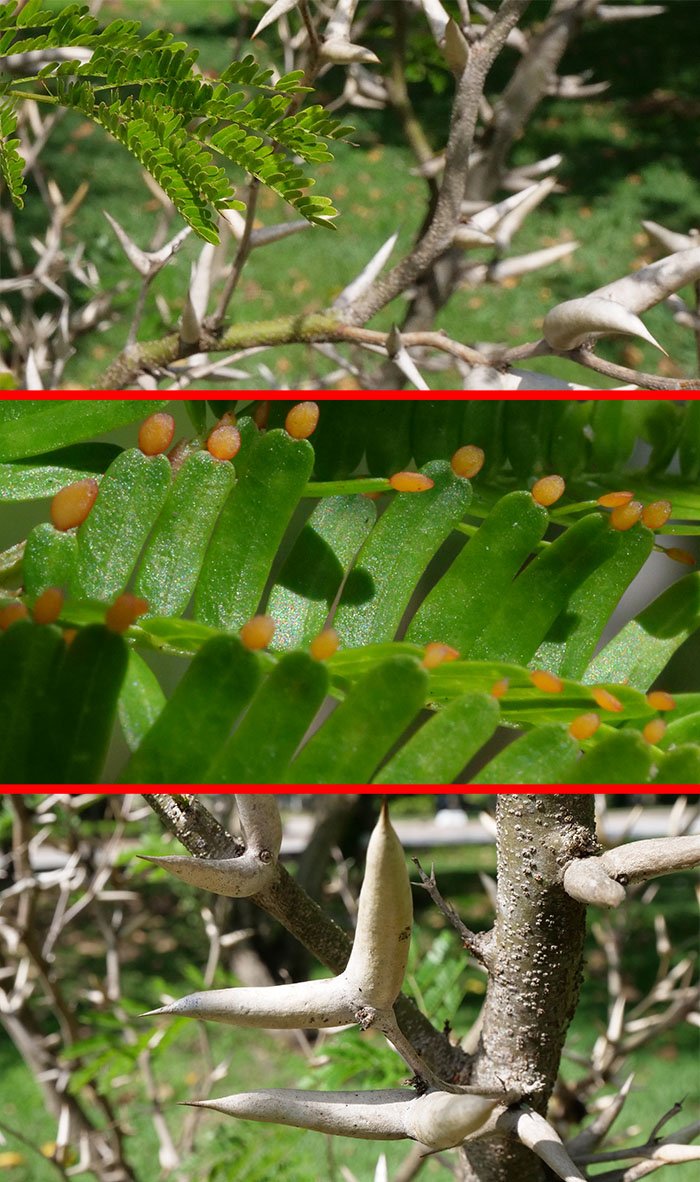
Dr. Joseph Thomas Miller of the Centre for Plant Biodiversity Research, CSIRO, Canberra, a world expert on Acacia and its former subgenera such as Vachellia, explains in a detailed description that there are 0.5-0.9 mm long “Beltian bodies” on the leaflets of Vachellia sphaerocephala.
“As is true for most ant-acacias found in open, relatively dry habitats, Beltian body production is high, more than half of the leaflets producing small Beltian bodies.”
Miller presents several other examples of Beltian bodies in ant-acacias, for example, in Vachellia cornigera (which was introduced to Florida) with photographs.
Our two most common Florida native species, Vachellia farnesiana and V. choriophylla, do not have Beltian bodies, and Beltian bodies appear to be absent in the two other Florida native species V. macracantha and V. tortuosa.
In looking at Vachellia photos online, it seems that species with large, and probably hollow, thorns, such as Vachellia sphaerocephala and V. cornigera, have Beltian bodies, while others do not. The native V. choriophylla has no thorns.
The theory is that the plant gives ants a home in the large hollow thorns, and nourishment from within Beltian bodies, and the ants give the plant protection from herbivores.